
Solutions
Industries
Resources
About
Game-day merchandise is not the team store: stadiums sell on every concourse, outside the gates, at pop-ups, in suites and through mobile order pickup.
Read time:
8
minutes
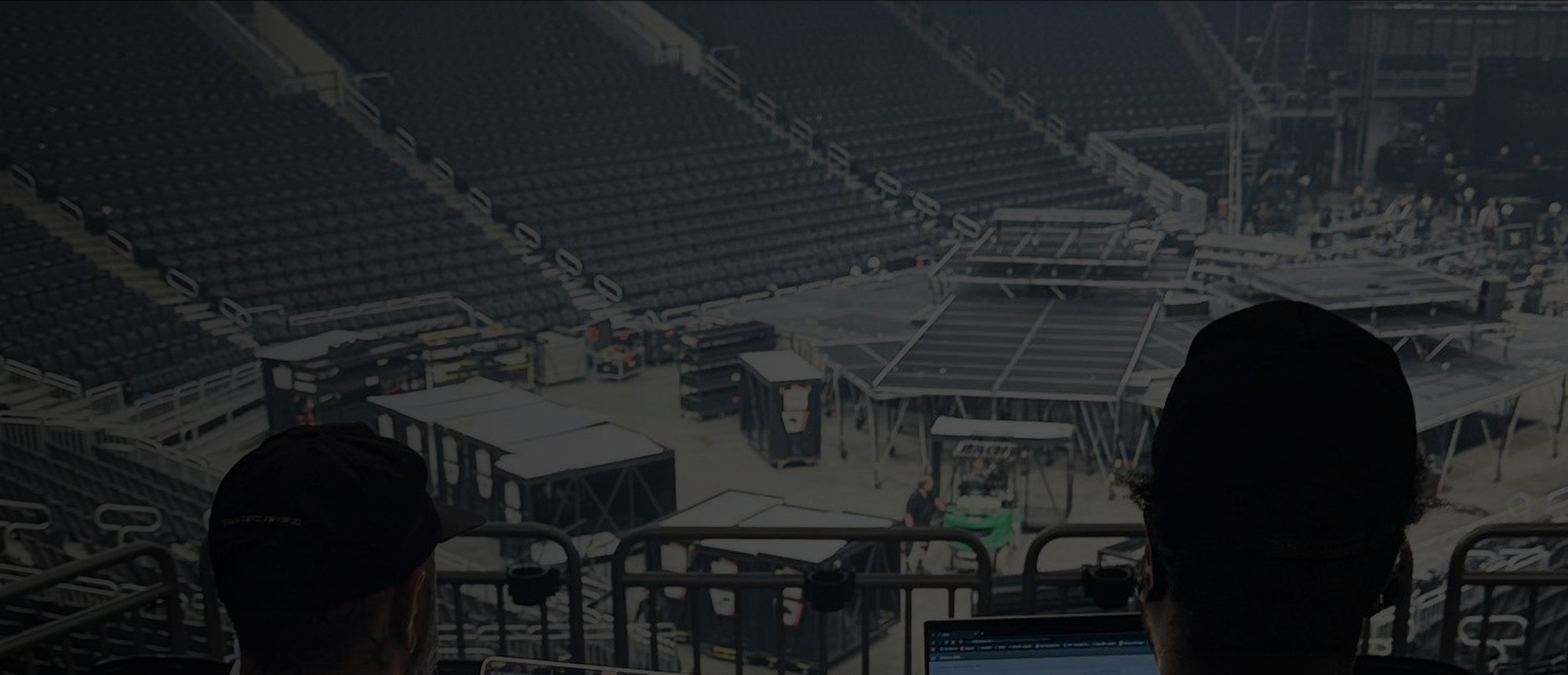
A stadium's team store and concessions often run on their own retail and food and beverage systems, but game-day merchandise needs an event-built POS. On game day, merchandise sells at stands on every concourse, in trailers and tents outside the gates, at pop-ups, in suites and through mobile orders for pickup, all in a few busy hours. atVenu is the live event commerce platform that 117 sports teams and tournaments use to run that selling and scale it for big games and concerts.
The team store is one shop, open all year. Game-day merchandise is a different job: many selling points across and around the stadium open for a few hours, and most sales arrive in waves when the gates open, at halftime and after the final whistle.
The teams that sell the most treat game day as one connected operation, not as a few extra store registers. When every stand, trailer, pop-up and mobile order runs on one system, the whole stadium's inventory and sales are visible in one place.
On big nights, fans arrive hours early, and many want merchandise before they reach their seats. Teams put trailers and tents outside the gates, in plazas and in parking lots, so more fans can buy before they head inside.

Clone menus, copy pricing and assign items to any stand, trailer or pop-up without rebuilding from scratch.

Use the tablets, iPads and phones you already have, with atVenu's card readers, or the Handheld: an all-in-one device that takes all payments with no extra card reader, runs on Wi-Fi or cellular, and handles small or large merch lines. The gear is flexible for any stand or line size.

Every device takes all forms of payment and is 100% offline capable, so a weak signal in the parking lot does not cost you a sale.

Trailers outside and stands inside draw from one live inventory, so stock can move to wherever demand is building.
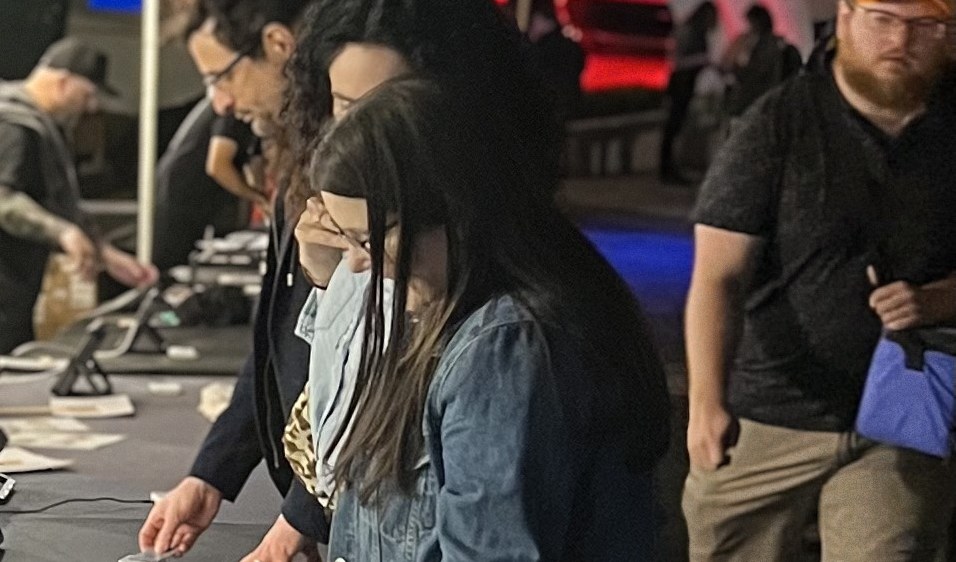
A regular-season game, a playoff game and a stadium concert need very different footprints. Your POS has to add selling points in minutes, reassign items and change prices to match demand inside or outside the venue, then scale back for the next date.
Michigan Stadium showed what that scale looks like. Happy Belly Vending ran merchandise, with atVenu powering point of sale and inventory visibility across the whole event footprint, inside and outside the gates.
Source: atVenu, "Record Merch Nights: What It Takes to Sell $5M in Merchandise at a Stadium Show" (January 2026).
With real-time reporting and location-level inventory visibility, the team could act while the show was on:

Spot demand building at specific stands and trailers while there is still time to respond.

Send stock to the stands and trailers that need it, and prevent early sellouts at high-traffic locations.

Monitor revenue across every location in real time, while keeping checkout fast at each register. Read how the night ran.
Teams that need more gear for a big date can have registers, Handhelds and concierge tablets shipped ready to sell.
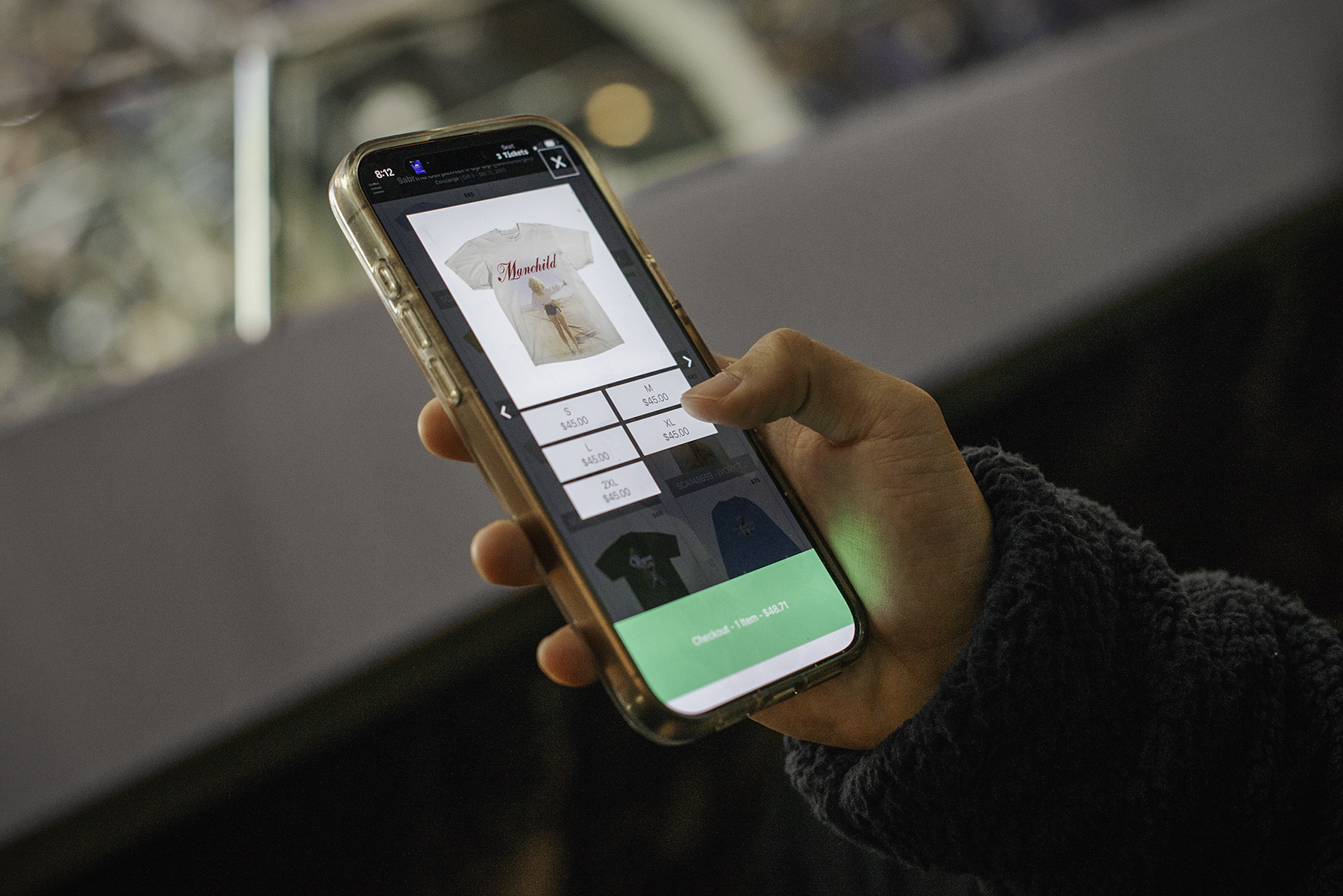
More venues are adding mobile ordering venue-wide and in their suites. Fans scan a QR code or open a link, browse merchandise on their phone, pay, and pick up at a pickup point when the order is ready, or have it delivered to their suite. There is no app to download, and it works for merchandise and for food and beverage.
Fans collect their order at a pickup point away from the main merchandise lines, and the item they wanted is already set aside for them.

Let fans lock in limited items before doors with QR codes and links tied to real inventory.
When an item sells out at the stadium, fans can still buy it and have it shipped after the event.
Pickup points and suite delivery can carry a sponsor's brand.

Each mobile order captures the fan's details to send order updates and say when the order is ready. You can view and use that information, and fans can opt in or out of having it saved.
Source: atVenu 2026 mobile ordering brochure. Averages, not guaranteed outcomes.
A growing share. In atVenu's 2025 mid-year venue merchandise insights, the share of arena and stadium fans buying merchandise rose from 21% in 2024 to 23% in 2025.
Share of arena and stadium fans buying merchandise
Bars are drawn to scale from zero. Source: atVenu 2025 mid-year venue merchandise insights (September 2025), more than 50,000 events across 700+ venues.
atVenu's Year in Review also finds an elevated share of fans buying merchandise at stadium shows. More buyers per event means more pressure on lines and stock in the same peak minutes, which is why extra selling points, mobile ordering and live inventory matter most in the biggest buildings.
Premium guests should not have to leave the suite to find merchandise. They scan a QR code or ask a concierge, and the order comes to them from the same live inventory as the rest of the stadium, with no extra merchandise stand to stock and staff.
Both compared with VIP purchases at a merchandise stand, across an analysis of dozens of venues. Observed averages, not guaranteed outcomes.
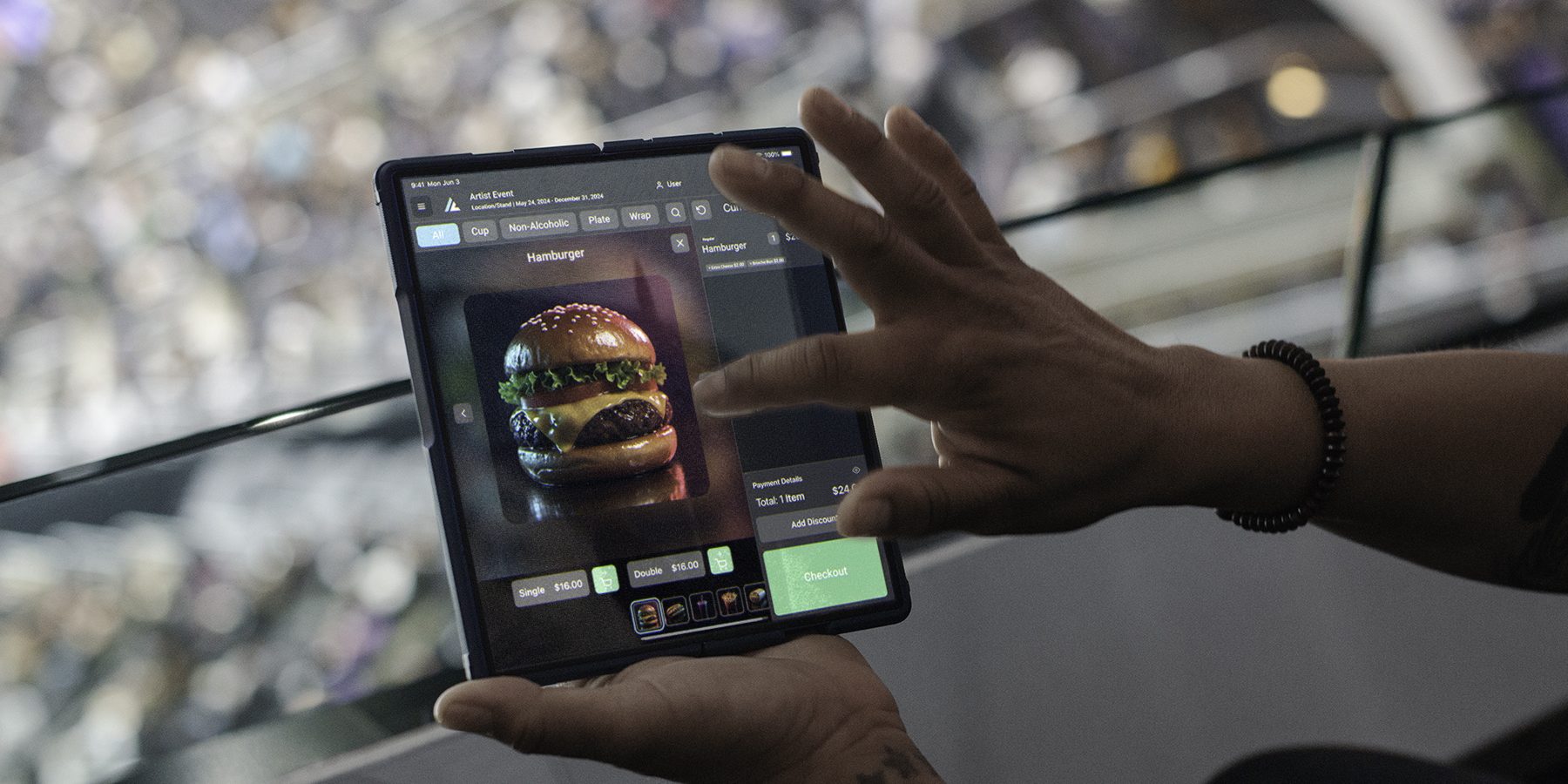
Whatever runs game-day merchandise has to perform in the busiest minutes, in every location, inside and outside the stadium.

Fast checkout, barcode scanning and size grids that keep long merchandise lines moving.

Add stands, trailers, pop-ups and roaming sellers for big games and concerts, then scale back for regular dates.
See live counts by stand, item and size, with low-stock alerts, so crews restock before the sale is lost.

Fans order from their phone and pick up, or get the order delivered to their suite.
Every device takes all forms of payment and is 100% offline capable.

Sponsor promotions and discounts at the point of sale, with transaction-level redemption data.

Digital counts and settlements, reconciliation by event, Excel exports and APIs.
Finance teams want to know how money moves and how every stand, trailer and pop-up reconciles. Here is the flow when settlement is digital.
Allocate inventory to each stand, trailer, pop-up and suite before doors.
Dashboards show what is selling, where, while the event runs.
Each location reconciles remaining stock against what sold.
Multi-party splits across artists, vendors, teams and sponsors are calculated in minutes.

Finance gets payment history, reconciliation reports, Excel exports and APIs.

Pay artists, vendors and teams from the settlement with atVenu Pay.
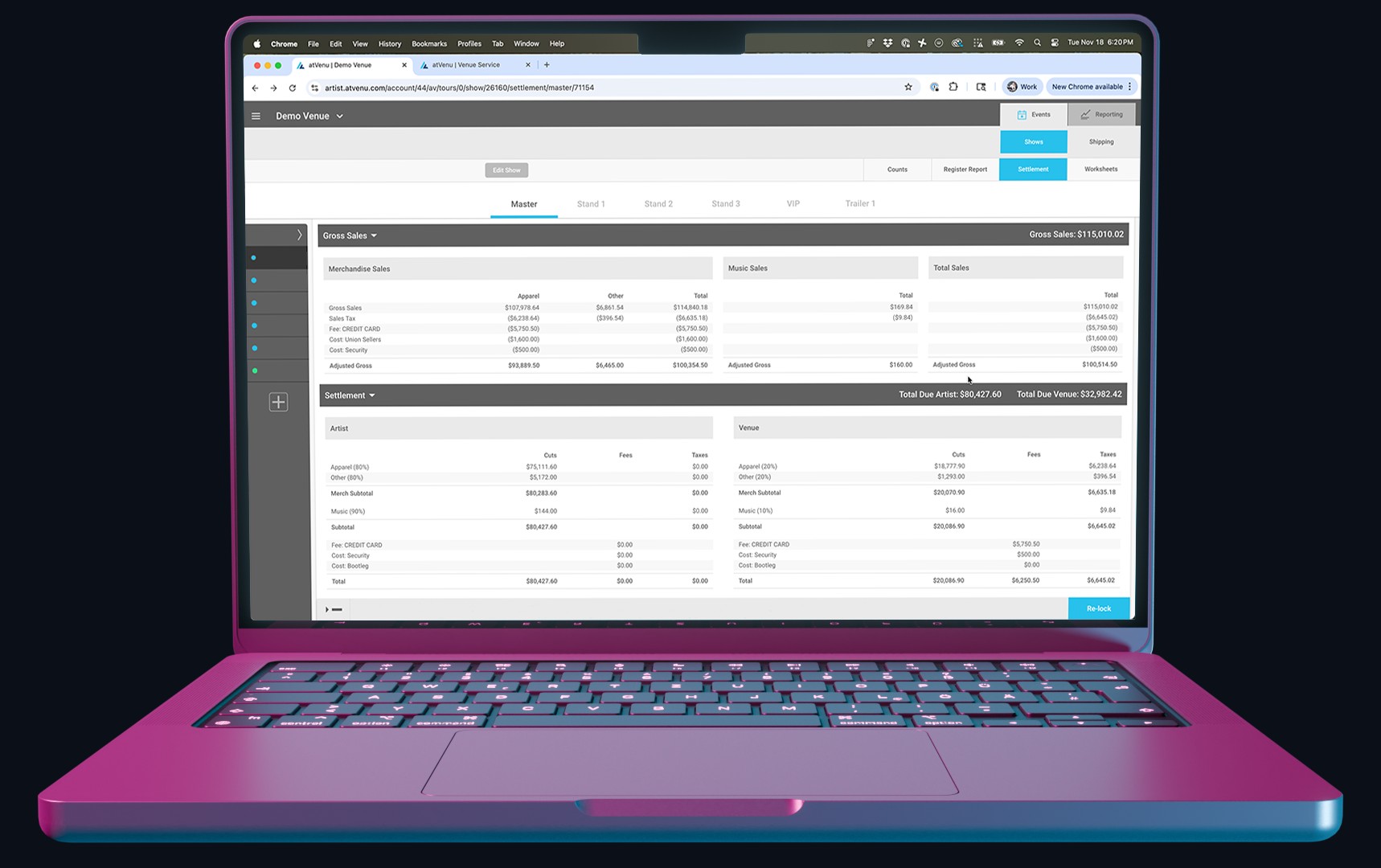
atVenu runs game-day merchandise across the whole footprint: concourse stands, trailers and tents outside the gates, pop-ups, suites and mobile order pickup, with one live inventory and one set of reports. Teams can keep the team store on its own retail system and use atVenu for everything that happens on game day. Teams can run food and beverage on the same platform where they choose to.
See how it works for sports teams and leagues, for merchandise and for mobile ordering.
Game-day merchandise is best run on an event-built POS, separate from the year-round team store. It runs concourse stands, trailers outside the gates, pop-ups, suites and mobile orders on one live inventory. atVenu is the live event commerce platform 117 sports teams and tournaments use for it.
No. The team store is one shop, open all year. Game-day merchandise sells at many locations across and around the stadium for a few hours, in waves, and needs selling points that scale up and down with each event.
Yes. With atVenu, trailers, tents and pop-ups outside the stadium use the same items, prices and live inventory as the stands inside, and every device is 100% offline capable.
Fans scan a QR code or open a link, order and pay on their phone with no app download, and pick up at a pickup point or have the order delivered to their suite. Mobile ordering works for merchandise and for food and beverage.
Not necessarily. With atVenu, a team can see game-day merchandise sales in real time, run sponsor promotions and offer VIP merchandise experiences even when it does not control the venue's POS.
Use the tablets, iPads and phones you already have with atVenu's card readers, or the Handheld, an all-in-one device with no extra card reader. Every device takes all forms of payment, is 100% offline capable and works for any stand or line size. Registers, Handhelds and concierge tablets can also be shipped ready to sell.
Yes. atVenu runs merchandise, food and beverage, premium and mobile ordering on one platform with one set of reports. A team can start with game-day merchandise and add the rest.
Published:
August 1, 2026